In the summer of 2025, images of Ukrainian soldier Andriy Pereverziev shocked the world. After returning from Russian captivity, he bore the inscription “Glory to Russia” and the letter “Z” burned into his skin. Journalists from Schemes conducted an investigation to determine where the branding was likely carried out and who may have been responsible.
Where it happened: DCTMA hospital
The reporters established that the procedure took place at the largest hospital in occupied Donetsk — the Donetsk Clinical Territorial Medical Association (DCTMA), renamed the Kalinin Republican Clinical Hospital in 2023.
Pereverziev recalled hearing the hospital’s name from medical staff. Schemes verified his account by matching his description of an eight-story building with a proctology department on the sixth floor — a configuration unique in occupied Donetsk.
Following Russia’s full-scale invasion, Russian officials and cultural figures regularly visited the hospital. In the summer of 2025, hospital director Ivan Plakhotnikov reported to President Vladimir Putin that “600 beds have been reserved, and assistance is being actively provided to those injured in the conflict and its participants.”
Key suspects: surgeons from Krasnodar
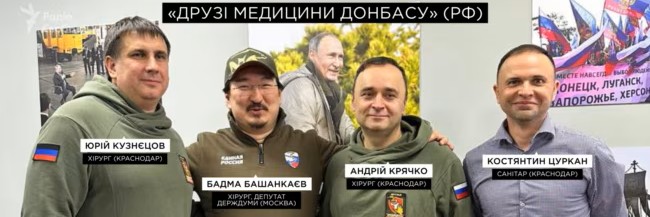
Two Russian doctors from Krasnodar emerged as key figures in the investigation: abdominal surgeon Yuriy Kuznetsov and proctologist Andrey Kryachko. Both work at the same hospital in Krasnodar and frequently perform surgeries together.
The journalists found that the two doctors publicly display pro-war symbols, including clothing bearing the “Z” emblem and the slogan “Putin’s team.” They have also posted photos referencing Soviet-era imagery and expressed support for Russia’s military campaign.
According to the investigation, Kuznetsov and Kryachko began traveling to Donetsk about six months after the start of the full-scale invasion as part of a group called “Friends of Donbas Medicine.” They regularly performed surgeries at DCTMA, often on the same days.
Reporters found multiple indications that both doctors were present at DCTMA on February 24, 2024 — the date when Pereverziev says the inscriptions were burned into his body — and attempted to contact them.
Kryachko did not respond. Kuznetsov initially denied being in Donetsk on that date but later said he had not operated on anyone that day.
Former DCTMA doctor Ihor Kirianenko, who spent seven years in Russian captivity and was released in August 2025, said the branding was most likely carried out by Russian doctors. In his view, local Donetsk physicians would have been unlikely to commit such an act.
The Prosecutor General’s Office of Ukraine said the findings of the journalistic investigation would be added to the criminal case file.
“This is undoubtedly one of the most brazen crimes committed during the full-scale invasion against prisoners of war,” said Taras Semkiv, head of the Department for Combating Crimes Committed in the Context of Armed Conflict at the Prosecutor General’s Office.