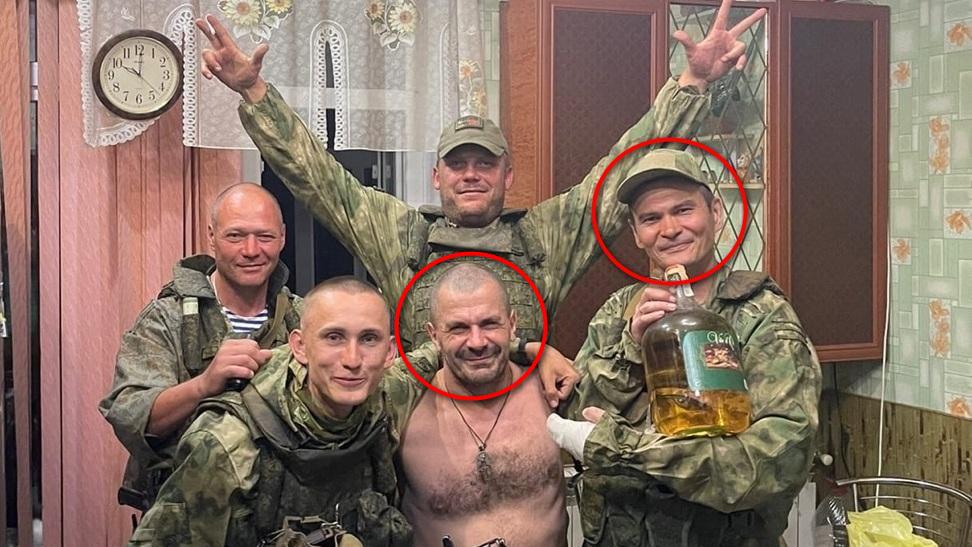
The Kherson City Court has convicted two servicemen of the 10th Separate Special Forces Brigade of the russian armed forces in absentia for robbing a private house in occupied Bilozerka.
What is known about the convicts
Sergey Petrovich Vaida (born August 28, 1980) is a russian citizen, a native of the village of Pleshchenytsia, Logoysk District, Minsk Region, Belarus. He is a serviceman of the 10th Separate Special Forces Brigade of the russian armed forces. Known to witnesses by the call sign “Krot”. He had no prior convictions for crimes in Ukraine. He has been on the international wanted list since September 2024.
Sergey Mikhailovich Suslov (born January 31, 1967) is a russian citizen, a native of the village of Troitsky, Talitsky District, Sverdlovsk Region. He is a serviceman of the 10th Separate Special Forces Brigade of the russian armed forces. He had no prior convictions for crimes in Ukraine. He has been on the international wanted list since September 2024.
Circumstances of the crime
The settlement of Bilozerka, Kherson District, was under occupation from March 1 to November 11, 2022. In April 2022, a unit of the 10th Special Forces Brigade of the russian armed forces was deployed there.
The owner of a large private household with an area of 500 square meters left for his daughter in Vinnytsia region on February 22, 2022. He left hired workers, who lived in an outbuilding on the same property, to look after it.
In the evening in late April 2022, Vaida and Suslov, together with three unidentified russian servicemen, entered the property without the owner’s permission, occupied the house and used the owner’s belongings and food for several months.
In early June 2022, the two convicts and their accomplices began actively looting the property. The workers observed them packing belongings into bags and sacks, taking them out of the house and loading them onto an armored personnel carrier parked by the gate, then driving away and returning for more items.
Three LG TVs, two refrigerators and a Gorenje freezer, two stoves, and alcohol were taken from the house. From the utility building — a walk-behind tractor, generators, a Honda Dio scooter, a seed drill, tractor wheels, three brushcutters, five angle grinders of various brands (Makita, DeWalt, Bosch, Sturm, Powermat), two rotary hammers, a jackhammer, a lawn mower, and other tools.
After the de-occupation of Bilozerka, the owner returned to the house in December 2022.
Police recorded signs of a prolonged stay by the occupiers — abandoned camouflage clothing and disorder in the rooms.
Several witnesses independently identified both convicts in photographs, including Vaida — by the call sign “Krot” and distinctive facial features. A photo found online, showing five armed servicemen in uniform posing in a room, was recognized by the victim and four witnesses based on the furniture and layout as a room in his house; among those depicted were Vaida and Suslov.
Verdict
On November 19, 2025, the Kherson City Court found Vaida and Suslov guilty in absentia of violating the laws and customs of war — robbery of a civilian committed by a group of persons by prior conspiracy (Part 2 of Article 28, Part 1 of Article 438 of the Criminal Code of Ukraine) — and sentenced each to 12 years in prison. The court also ordered them to jointly compensate the victim for 228,100 hryvnias in damages and to pay court costs to the state — 13,856 hryvnias each.
Suslov’s defense appealed the verdict, arguing insufficient evidence and questioning the admissibility of the identification protocols. On March 18, 2026, the Kherson Court of Appeal dismissed the appeal in full.
The court noted that four witnesses independently identified Suslov and gave consistent testimonies that corroborated each other and other case materials. Arguments regarding the photographs were also rejected — the court stated that the law does not require indicating the origin of photographs in the protocol and that the images presented did not have significant differences.
The verdict has entered into force. The prison term will be calculated from the moment of actual detention.