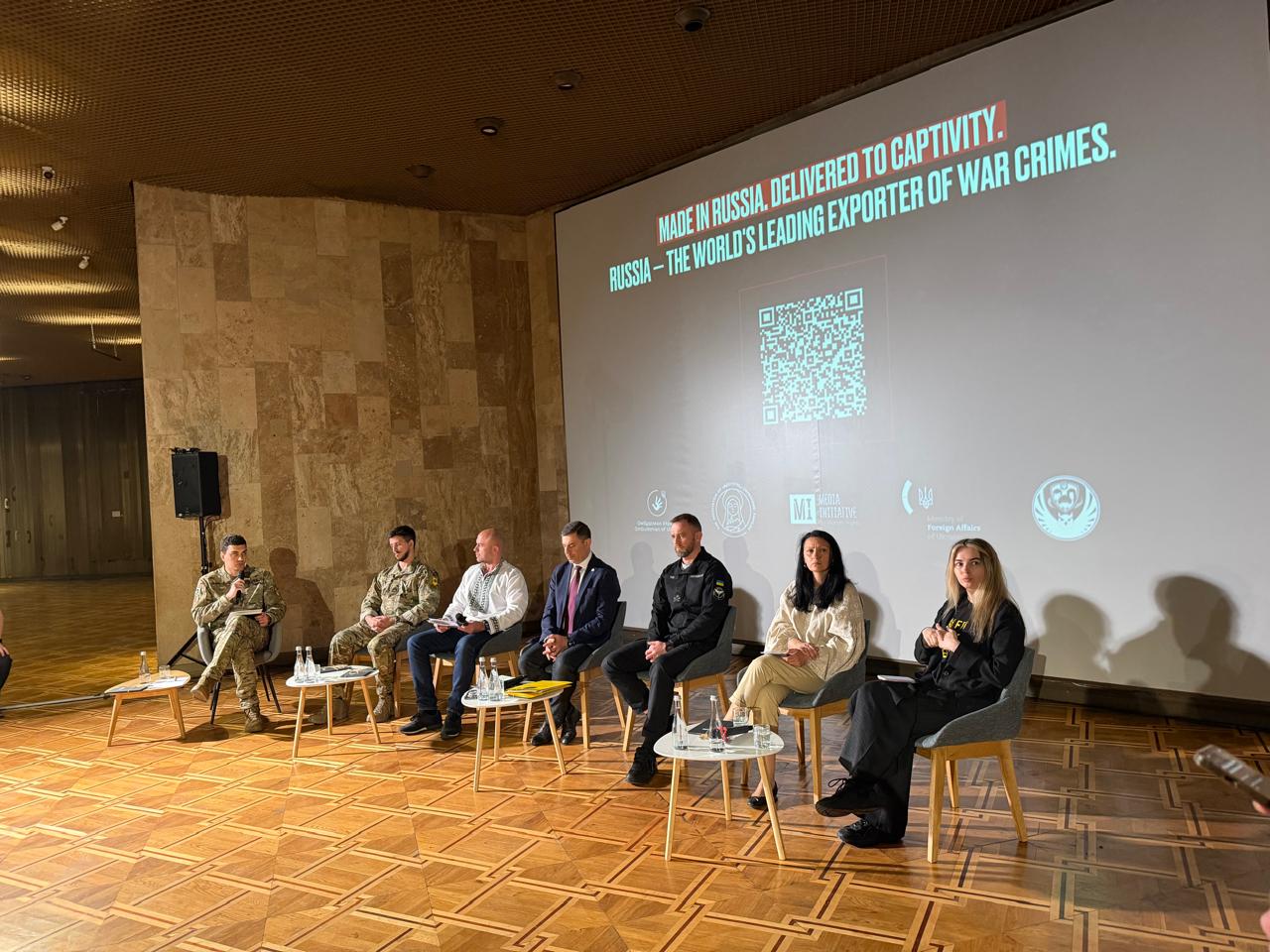
The Verkhovna Rada Commissioner for Human Rights, Dmytro Lubinets, stated that the russian federation has tortured at least 406 Ukrainian citizens in captivity — both military personnel and civilians.
He made the statement public on May 22 during the presentation of the project “Made in russia. Delivered into Captivity.” The event marked the fourth anniversary of the Mariupol garrison’s withdrawal from Azovstal after 86 days of the city’s heroic defense. At the time, the defenders of Mariupol, under provided guarantees, complied with the order of the military command to save their lives. However, the russian federation violated those guarantees — and a large part of the Azovstal defenders have now been suffering abuses in russian captivity for the fifth year.
“Today, within this project, we are officially recording that, according to our data, the russian federation applies 695 forms of torture, including physical and psychological abuse and sexual violence. Prisoners of war are strangled, beaten, subjected to electric shocks, set upon by dogs, and sometimes forced to stand in one place for up to 18 hours. As soon as they begin to squat, they are immediately beaten,” Ukrinform quotes Lubinets as saying.
The Ombudsman noted that inhumane detention conditions and torture are systematic practices applied to Ukrainian prisoners of war. These include unsanitary conditions and starvation as a method of coercion. A total of 860 cases of improper detention conditions have also been recorded.
“One of the types of torture is the so-called ‘barber’, when during shaving not only hair is deliberately cut off, but also pieces of skin from the scalp. If a person starts screaming, they are immediately beaten again and subjected to electric shocks,” he said.
“According to our data, 406 Ukrainian citizens in the status of prisoners of war and civilian hostages, who were verified and confirmed by the International Committee of the Red Cross or by other methods and sources, were tortured and returned to Ukraine, unfortunately, in coffins,” he said.
Lubinets noted that the most common cases involve torture leading to broken ribs and damage to internal organs, which in many cases resulted in death. This also includes the failure to provide medical assistance after torture.
In addition, during the presentation, the Commissioner said that, according to Ukrainian data, 2,112 people have been convicted by the Russian Federation.
“This is a separate crime committed by the russian federation, issuing unlawful court rulings of 20, 23, 25 years or life imprisonment against official Ukrainian prisoners of war,” he said.
The Ombudsman reported that international partners have documented 29 detention sites: 18 on the territory of the Russian Federation and 11 in temporarily occupied territories of Ukraine. At the same time, Ukrainian intelligence agencies have verified 186 detention sites for Ukrainian prisoners of war and civilian hostages, covering the entire territory of russia and the temporarily occupied territories. There are also detention facilities in Siberia. According to Lubinets, conditions in these places are largely the same and are unsuitable for humane detention.
He stressed that the weak international response to documented systematic torture signals to russia that it can continue these practices with impunity.
“As the Ombudsman of Ukraine, I once again publicly state: there is no international human rights protection system for a country that tortures prisoners of war, civilian hostages, and abducts Ukrainian children. That country is the russian federation. It simply does not exist. None of the international instruments work there. We must talk about this and look for additional ways to exert pressure on the russian federation,” he said.
Lubinets also criticized the work of the Red Cross.
“Are there representatives of the International Committee of the Red Cross here? We have separately invited them. They are not in the hall. They do not want to hear once again that there is a problem with the implementation of their mandate. We understand that this is primarily the position of the russian federation. But what else are you doing to change it? Just negotiations? Perhaps they can bring results, but certainly not the kind we expect. Regarding the prisoners of war among the defenders of Mariupol — Olenivka. Everyone knows the russians did it. Fifty-three men, verified by the ICRC as prisoners of war, were killed and more than 130 were wounded. Where is the reaction? There is none. And there will be none unless we all understand that we must apply pressure, demand accountability, and do everything to ensure that every representative of the russian federation is brought to justice,” he said.