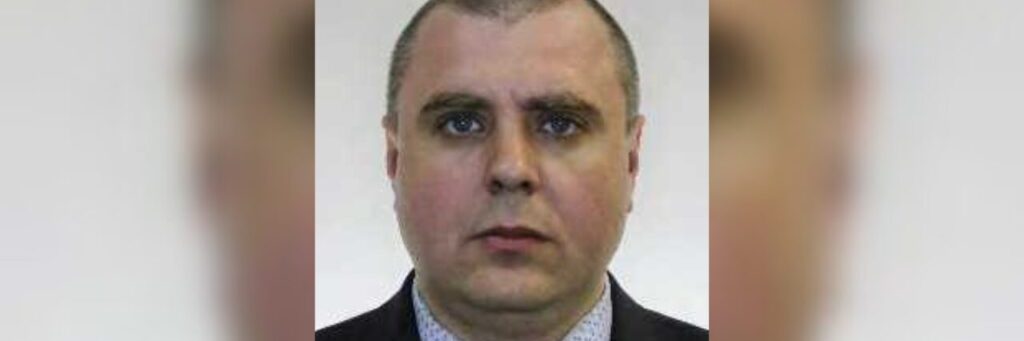
On January 6, 2025, the Khadzhybeyskyi District Court of Odesa issued an in absentia verdict against Yuriy Belyatskyi, a russian Federal Security Service (FSB) officer accused of kidnapping, torturing, and coercing Ukrainian military personnel into cooperation during the occupation of Kherson. He was sentenced to 12 years in prison.
Background of the perpetrator
Yuriy Petrovich Belyatskyi, 45, was born in Berdsk, Novosibirsk Region, russia. He holds a university degree and serves in the Ninth Directorate of the Department of Operational Information within the FSB’s Fifth Service.
Following the launch of russia’s full-scale invasion of Ukraine, Belyatskyi led a group of FSB officers in occupied Kherson. Their mission was to identify and detain Ukrainian service members, law enforcement officers, veterans of the Anti-Terrorist Operation and Joint Forces Operation, as well as pro-Ukrainian activists who remained in the city.
During these operations, Belyatskyi used a pseudonym and was noted for particular brutality.
The crime
On March 31, 2022, at around 1 p.m., an FSB officer accompanied by russian soldiers broke into the apartment of a Ukrainian Armed Forces officer in Kherson, where he lived with his wife and minor son. Masked and armed men conducted an illegal search of the apartment, stealing USD 5,000, EUR 1,000, expensive electronic equipment, a Longines wristwatch worth approximately EUR 2,100, and other valuables.
The officer was not at home at the time. He later received a phone call warning that he would never see his wife and child again if he failed to return. When he arrived, he was met by an FSB officer who interrogated him in the kitchen, demanding information about Ukrainian military units, their locations, contacts, and family members.
The victim was beaten, restrained with plastic ties, had his face covered, and—under threats against his wife and son—was taken to a location where he was subjected to torture until late in the evening.
He was tied to a chair and repeatedly beaten, losing consciousness several times. The abuse included a mock execution, during which a soldier fired two shots close to his head. The perpetrators threatened to kill not only him but also his wife and child.
After russian forces discovered information on the officer’s phone about a destroyed russian tank column, the beatings intensified as an act of “revenge.”
Exhausted physically and psychologically, the victim was ultimately given a choice: cooperate with the FSB or face death along with his family.
Believing this was his only chance to survive and protect his loved ones, he agreed. At that moment, the interrogating FSB officer removed his balaclava, allowing the victim to see and remember his face.
During the investigation, the victim worked with a forensic sketch artist and later identified Belyatskyi from photographs provided by the Security Service of Ukraine (SBU).
About a week later, the family managed to escape Kherson to Ukrainian-controlled territory. The victim subsequently went into hiding and changed his place of residence several times. While staying in Mykolaiv, he reported visits from unknown individuals whom he believed were attempting to kill him. An FSB officer later contacted him by phone, after which the victim cut off communication.
The sentence
The court found Belyatskyi guilty under Article 28(2) and Article 438(1) of Ukraine’s Criminal Code for violations of the laws and customs of war and sentenced him to 12 years’ imprisonment.
In its ruling, the court stated that the crime was motivated by “hatred toward the Ukrainian nation, the desire to destroy Ukrainian statehood, a sense of ethnic superiority, and contempt for Ukrainian culture and identity.”
The court also emphasized that the victim survived solely due to his own resourcefulness, having deliberately misled his captors.
Belyatskyi is currently believed to be hiding in russia. His prison term will begin upon his arrest.