For the first time, the UN Independent International Commission of Inquiry on Violations in Ukraine has labeled the removal of Ukrainian children by russia as a war crime. This was reported in the commission’s report presented at the 61st session of the UN Human Rights Council in March 2026.
The commission verified the deportation of 1,205 children from five regions of Ukraine. In particular, it confirmed the removal of 995 children from 11 institutions in the occupied territories of the Donetsk and Luhansk regions just before the full-scale invasion in 2022.
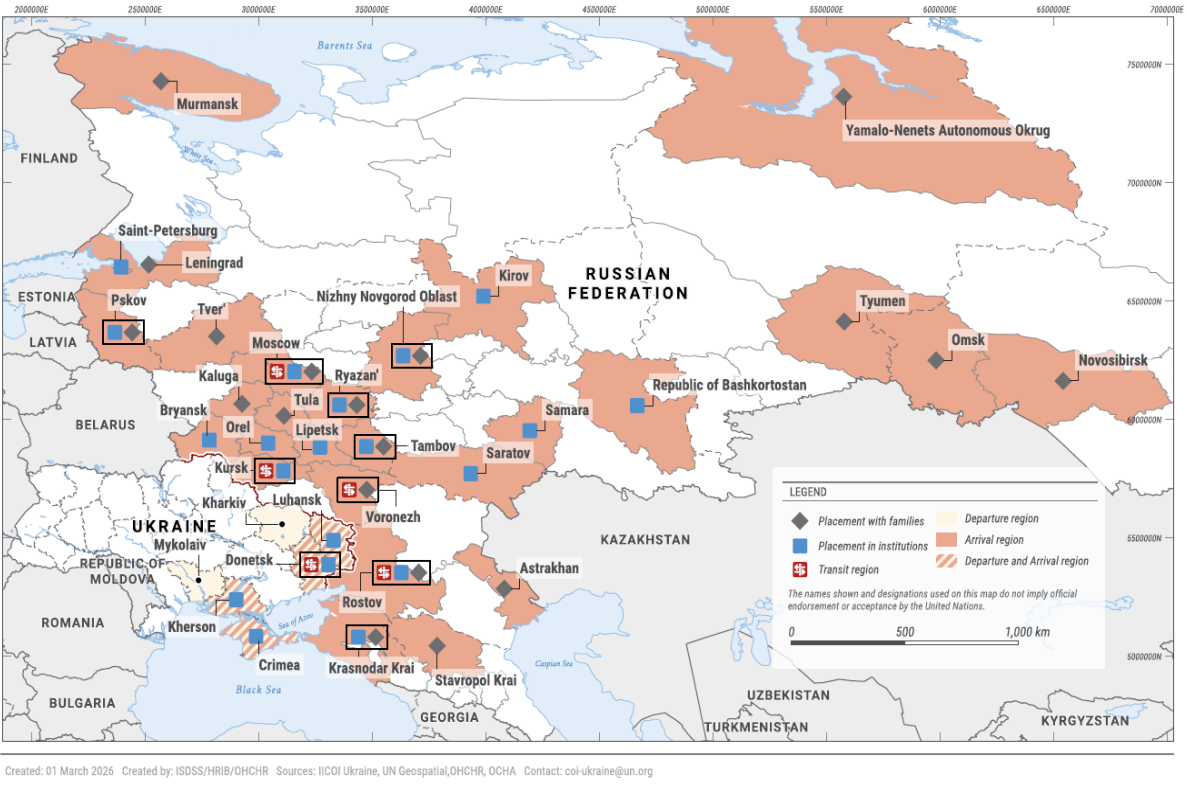
The children were first sent to transit centers and later distributed among institutions and families in 21 regions of the russian federation.
A map of the resettlement of children deported by russia:
The commission concluded that these actions were not a simple “evacuation,” as claimed by the russian federation, for several reasons.
- First, the russian authorities did not seek the consent of parents, legal guardians, or the Ukrainian government, which is required under international law.
- Second, instead of providing temporary protection, the russian authorities promoted the long-term placement of children in russian families or institutions. The children were granted russian citizenship, and their profiles were placed in databases for adoption or foster care.
- The process was coordinated at the highest state level, including by putin and structures subordinate to him. This indicates a pre-planned policy that makes these actions a crime against humanity.
The russian authorities did not inform parents about the whereabouts of their children, which the commission qualified as enforced disappearance.
The russian federation has not created any mechanism for the repatriation of children. The burden of searching for and organizing their return fell entirely on the shoulders of parents and relatives, who faced obstacles, delays, and security risks.
At the time of writing, 80% of the children in the investigated cases had not yet returned home. Children with disabilities and those from boarding institutions have the least chance of returning.
Children who managed to return spoke of deep fear and anxiety. One of the boys said: “I was sad, I was scared. I was worried that I would have to live in the russian federation.”
- The Commission recommends that the russian federation:
(a) Cease any deportation of children from Ukraine or transfers within occupied areas of Ukraine.
(b) Provide reliable and comprehensive information about all children who have been deported to the russian federation or transferred within occupied areas of Ukraine, including on their fate and whereabouts, legal status, well-being and health conditions. This should include information about placement of children in institutions or with russian families, including through adoption, as well as any change of citizenship.
(c) Restore and facilitate effective communication between all children who have been deported to the russian federation or transferred within occupied areas of Ukraine with their parents, legal guardians, families or caregivers.
(d) Promptly and proactively initiate the immediate, safe and unconditional return to Ukraine of children deported to the russian federation or transferred within occupied territories in Ukraine, in accordance with their best interests and in conformity with international law.
(e) Cooperate with Ukrainian authorities in their efforts in relation to a DNA registry that would aid in the identification and recovery of children.
(f) Immediately cease any measure to change the legal status of any child deported or transferred.
(g) Provide unimpeded access to United Nations entities and other relevant international monitoring and humanitarian organizations to verify the situation of Ukrainian children, safeguard their rights and well-being, and take all measures necessary to secure their immediate, safe and unconditional return to reunite with their parents, legal guardians, families or caregivers.
- The Commission recommends that Ukraine:
(a) Continue its work towards the verification of the identity and a complete list of children who were deported to the russian federation or transferred within occupied areas of Ukraine.
(b) Strengthen its efforts in relation to the DNA registry that would aid in the identification and recovery of children.
(c) Ensure access to multidisciplinary, coordinated and comprehensive support and services to children and their families to address their specific immediate, short-term and long-term needs, and ensure the fulfilment of their rights.
- The Commission recommends that the international community:
(a) Coordinate and reinforce its efforts to impress upon the russian federation the urgency to facilitate the return of children who have been deported to the russian federation or transferred within occupied areas of Ukraine.
(b) Support Ukraine in responding to the needs of children, parents, legal guardians, relatives and caregivers.
(c) Contribute both financially and with technical assistance towards a range of multidisciplinary and coordinated efforts — including legal, social, psychological, medical, educational, and rehabilitation and reintegration services — for children who have returned.